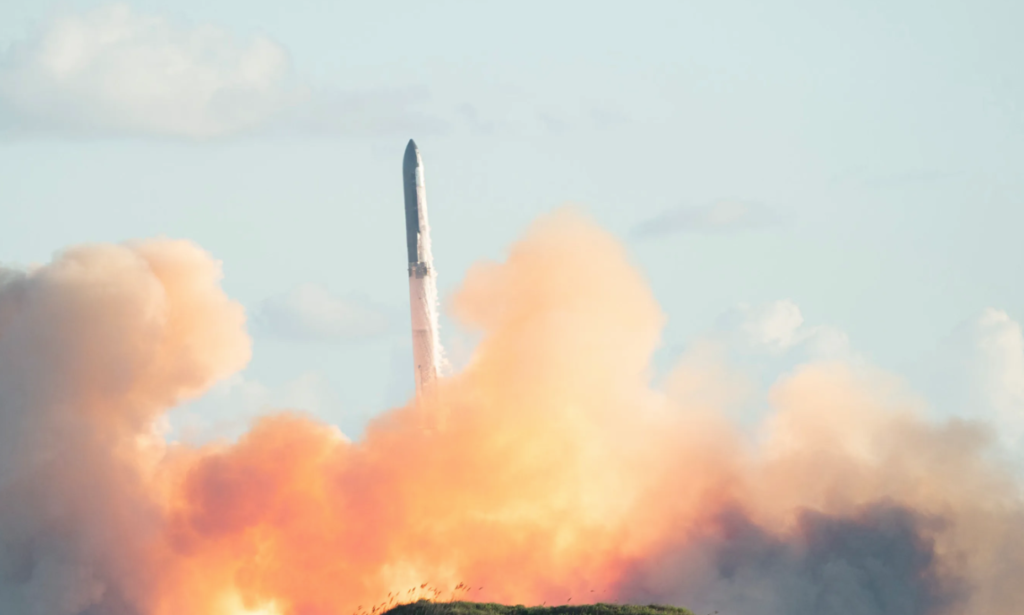
After thirteen test flights that deliberately avoided reaching a stable orbit, SpaceX is finally ready to let Starship go all the way. The FAA has confirmed September 22 as the target date for Starship Flight 14, a mission that will attempt to put the vehicle’s upper stage into real low Earth orbit for the first time and deploy operational Starlink satellites along the way. Here’s what makes this flight fundamentally different from everything that’s come before it.
Why This Flight Is Actually Different From Every Previous Starship Launch
Every Starship test flight to date has flown a deliberately suborbital trajectory, a safety-driven design choice that let SpaceX test ascent, engine performance, and reentry without needing a deorbit burn to bring the vehicle back down safely. Flight 14 changes that. According to SpaceX’s own mission description, reaching genuine orbital velocity is the necessary next step before Starship can begin operating as a fully and rapidly reusable launch vehicle rather than purely an engineering test article. In practical terms, this is the flight where Starship stops rehearsing orbit and actually goes there.
The Mission Profile: Six Orbits and a Pacific Splashdown
Flight 14 is scheduled to launch from SpaceX’s Starbase site in South Texas during a 75-minute window opening at 12:15 UTC (7:15 a.m. Eastern). Once in orbit, the mission is expected to run for roughly 10 hours, completing approximately six full orbits of Earth before Starship’s upper stage comes down for a splashdown in the Pacific Ocean west of Chile. That extended orbital coast gives SpaceX significantly more data on how the vehicle performs in space over time compared to the shorter suborbital hops of previous test flights.
Deploying Starlink V3: The Real Business Case Behind This Flight
This isn’t purely a research mission. Ship 41 is expected to deploy operational, production Starlink V3 satellites into a working orbit as part of Flight 14, marking the first time Starship has placed real, revenue-generating satellites into actual service rather than performing a mock deployment test. SpaceX CFO Bret Johnsen has told investors the flight is intended to generate revenue directly through this satellite deployment, underscoring that Starship is being pushed toward commercial operation rather than remaining purely a development platform. Because Starship’s payload capacity dramatically exceeds what fits inside a Falcon 9 fairing, deploying V3 satellites at scale requires Starship specifically — Falcon 9 physically can’t carry them in the necessary quantities.
Why the Launch Date Keeps Slipping
Getting to September 22 wasn’t a straight line. The target date has moved at least three times in as many weeks, first slipping from September 18, then briefly appearing as September 15 on internal planning documents, before settling on the current September 22 target with a backup opportunity on September 23. SpaceX hasn’t publicly detailed a specific reason for each individual delay, though this kind of schedule movement is fairly typical for a complex orbital-class launch involving new hardware modifications, and industry trackers note that Starship’s launch dates have slipped before without derailing the broader program.
What Went Wrong Last Time, and What’s Been Fixed
Flight 14 follows directly from lessons learned on Flight 13, which launched on July 24 and achieved the first-ever deployment of next-generation Starlink V3 hardware along with an in-space engine relight test. That relight test didn’t go perfectly, though — SpaceX has described how the three center engines on that flight showed signs of ice clogging during the maneuver, triggering an early end to the burn. Ahead of Flight 14, SpaceX has made hardware modifications and software changes specifically aimed at improving engine relight reliability, directly targeting the failure mode observed on the previous flight.
No Catch This Time — That’s Coming Later
Unlike some recent Starship missions, Flight 14 will not attempt to catch either the Super Heavy booster or the Starship upper stage using the “chopstick” arms at Starbase’s launch tower. Instead, Booster 21 is expected to attempt a soft splashdown in the Gulf of Mexico, following an anomaly on a previous booster’s boostback and landing attempt. SpaceX has indicated that a ship catch attempt is being saved for the subsequent Flight 15, with Elon Musk reportedly putting the odds of a successful catch on that later flight at somewhere between 50 and 60 percent.
Flight 15 Is Already Being Prepped in Parallel
Notably, SpaceX isn’t waiting for Flight 14’s outcome to begin preparing for what comes next. Ship 42, the vehicle designated for Flight 15, was already transported to Orbital Launch Pad 2 and lifted into the tower’s chopstick arms for rehearsal testing in mid-September, even while Flight 14 hardware sat ready to launch. Those rehearsals — including arm reconnection tests and pin geometry validation — are aimed at reducing risk on the ship-catch maneuver Flight 15 is expected to attempt. If Flight 14 succeeds, reports suggest Flight 15 could follow on a notably compressed timeline, potentially within about a month, a much faster turnaround than the multi-month gaps that have typically separated individual Starship test flights.
What Success (or Failure) Would Mean for SpaceX’s Roadmap
A successful Flight 14 would represent one of the most consequential milestones in the entire Starship program to date — proof that the vehicle can reach real orbit, operate there for an extended period, and deploy revenue-generating payloads, all in a single mission. That combination directly validates Starship’s core business case as a next-generation launch platform rather than solely a demonstration vehicle. A setback, on the other hand, wouldn’t necessarily derail the broader program given SpaceX’s well-established iterative testing approach, but it would likely delay the compressed Flight 15 timeline currently being prepared in parallel, along with the broader push toward the kind of rapid, airline-style reusability SpaceX has been targeting for Starship for years.