Honor’s strangest phone yet just went through the toughest durability gauntlet in tech YouTube: JerryRigEverything’s full battery of scratch, bend, flame, and teardown tests. The Robot Phone’s headline feature — a motorized, pop-out three-axis gimbal camera arm — is unlike anything else on the smartphone market, and the results expose exactly where that mechanical ambition holds up and where it doesn’t.
What Makes the Honor Robot Phone Different
The Robot Phone’s defining feature is a titanium gimbal arm that pops out of the phone’s body and rotates independently, housing a 200-megapixel periscope telephoto camera with optical image stabilization. It’s marketed as the first smartphone with a genuine three-axis gimbal built directly into the device, rather than relying purely on software or sensor-shift stabilization the way conventional flagships do. That single feature is also what drove nearly every other design decision Honor’s engineers had to work around, according to reviewer Zack Nelson’s teardown.
The Scratch and Flame Tests: How the Display Held Up
Nelson’s standard scratch test showed the Robot Phone’s display glass behaving like most modern flagship panels — visible scratch marks appeared at a level 6 pick, with deeper grooves at level 7, in line with typical Gorilla Glass-class performance. The display also held up to direct flame exposure for 26 seconds without failing, a stronger result than many phones manage in the same test. On the two most common durability benchmarks, the Robot Phone performs like a conventional flagship rather than a fragile mechanical experiment.
The Bend Test: No Structural Weakness Found
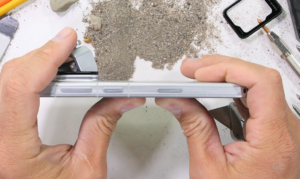
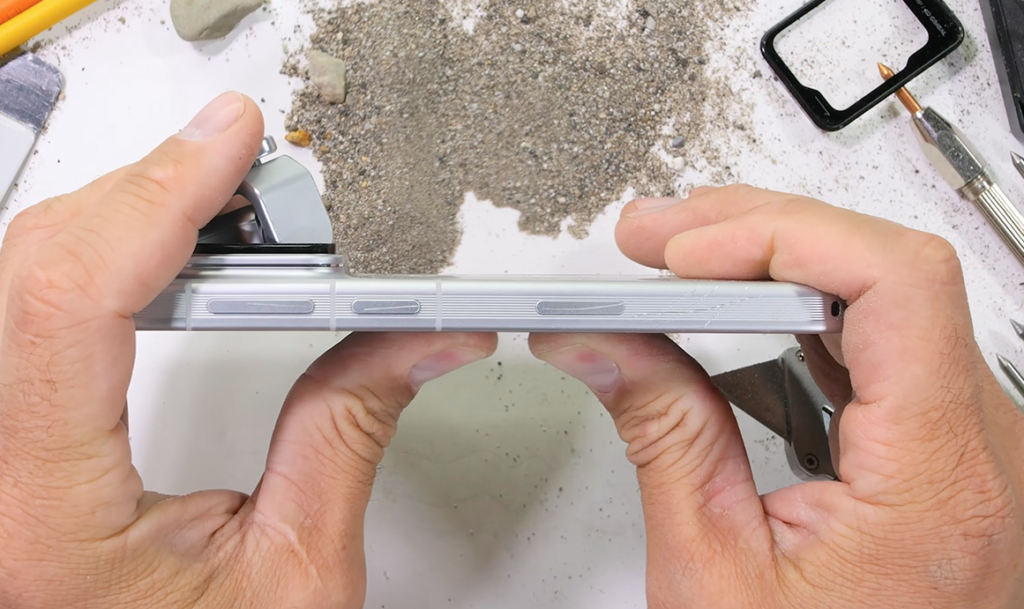
Given how many moving parts and internal joints the gimbal mechanism requires, the bend test was arguably the most important checkpoint — and the Robot Phone passed cleanly. The aluminum frame showed no flexing or cracking under pressure, and reviewers noted the phone barely moved despite unusual antenna-line placement near the hinge area of the gimbal arm. For a device built around a fundamentally unconventional internal structure, holding firm under bending stress is a meaningful engineering win.
The Real Weak Point: Dust and Sand Exposure
Where the Robot Phone actually struggled was dust and debris resistance. After deliberately exposing the gimbal mechanism to sand and dirt, Nelson found the motorized arm jammed and stopped functioning entirely — and compressed air wasn’t enough to restore it. The issue traces directly back to the gimbal’s mechanical design: any moving part that needs to rotate and extend from the phone’s body inevitably requires openings that standard dustproofing and waterproofing methods aren’t built to seal.
Why the IP54 Rating Matters More Than It Sounds
Most current flagship phones from Samsung and Apple carry an IP68 rating, meaning they can survive full submersion in over a meter of water. The Robot Phone is rated IP54 instead — splash-resistant at best, and only when the gimbal arm is fully retracted into the body. That’s a meaningful step down for a device priced in flagship territory, and it puts real limits on how the phone can be used outdoors, particularly at the beach or in dusty environments where the gimbal is more likely to be extended and exposed.
Inside the Phone: What the Teardown Revealed
Getting inside the Robot Phone turned out to be more straightforward than the exterior gimbal complexity might suggest. The rear cover is plastic rather than glass, making it comparatively easy to remove, and the battery — while glued in place — is still reasonably accessible for replacement compared to some more tightly sealed flagships. Inside, Honor used a dual-stacked motherboard layout to free up internal space for the gimbal mechanism, along with braided wiring, an unusual choice necessitated by the moving components that connect the gimbal arm to the rest of the phone’s internals.
Battery, Charging and the Vapor Chamber Trick
One of the more clever engineering solutions inside the Robot Phone involves heat management. Rather than mounting a separate vapor chamber elsewhere in the chassis, Honor glued it directly to the back of the display itself, effectively using the screen as an additional heat dissipation surface. That decision likely reflects how little internal space was left over once the gimbal mechanism’s motors and hardware were accounted for. The phone houses a 7,060mAh battery paired with 120W fast charging, a genuinely large capacity that helps offset the power demands of running a motorized camera system on top of everything else a modern flagship needs to power.
Price and Availability: Is It Worth the Risk?
The Honor Robot Phone currently sells for roughly $1,500 and remains available only in China, with no confirmed timeline for official release in the US, Europe, or other international markets. At that price point, buyers are paying flagship money for a device that trades standard IP68 water and dust resistance for a genuinely novel camera mechanism — a trade-off that will appeal strongly to some and be an immediate dealbreaker for others, depending on how much weight they put on ruggedness versus photographic novelty.
What This Means for the Future of Moving Camera Phones
The Robot Phone’s test results tell a clear story: mechanical camera innovation and traditional smartphone durability standards are still in tension with each other. Honor’s engineers solved the structural rigidity problem convincingly, proving a phone built around a moving robotic arm doesn’t have to be structurally fragile. But the dust and water resistance compromise shows that as long as a phone needs an opening for a mechanism to physically move in and out of its body, matching the sealed, all-glass durability of a conventional flagship remains a genuinely hard problem — one that will likely shape how cautiously other manufacturers approach similar moving-camera designs going forward.