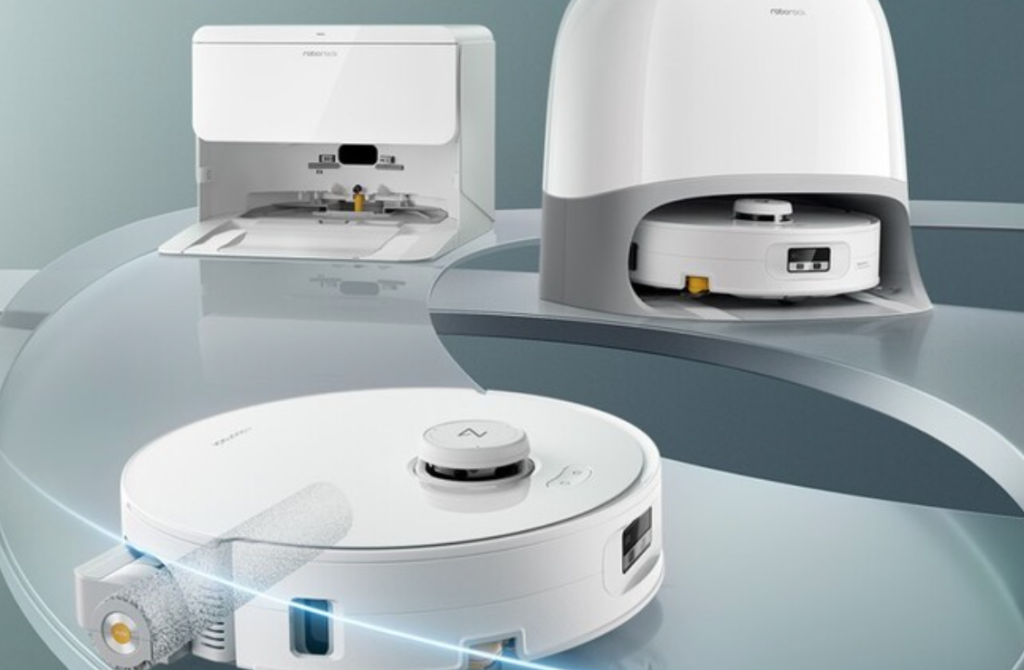
After years of relying on spinning or vibrating mop pads like nearly every other robot vacuum brand, Roborock has introduced its first-ever roller mop system on the Qrevo Curv 2 Flow, the successor to what was originally the company’s flagship model. It’s a genuinely different approach to robotic mopping, and early hands-on testing suggests it’s also the most powerful robot mop currently on the market — with one significant catch that keeps it from being a flawless upgrade.
What Model We’re Actually Talking About: Qrevo Curv 2 Flow
The original Qrevo Curv launched as Roborock’s flagship robot vacuum, priced around $1,600 and best known for its ability to climb over thresholds up to four centimeters and its distinctive curved, low-profile docking station. Its successor, the Qrevo Curv 2 Flow, keeps that same core design language while adding a handful of spec bumps — most notably, the roller mop technology that gives this generation its real headline feature. Pricing has actually come down for the new model to around $1,000, positioning it as a more approachable option as Roborock’s broader lineup has expanded to include the even more premium Saros 20 above it.
What a Roller Mop Actually Is (And Why It’s a First for Roborock)
Most robot vacuums on the market, including Roborock’s own previous generations, use either spinning circular pads or a flat, vibrating mop plate to clean hard floors. A roller mop instead uses a continuously rotating cylindrical roller, similar in concept to how a traditional wet mop works, that stays wet with a constant stream of fresh water while a built-in scraper removes dirt from the roller’s surface during operation. Roborock calls its version SpiraFlow, and it marks the first time the company has moved away from pad-based mopping in any of its products.
How the SpiraFlow System Works
The SpiraFlow roller spins at up to 220 rotations per minute while applying up to 15 newtons of downward pressure against the floor — pressure that reviewers have specifically flagged as noticeably stronger than what typical spinning-pad mop systems can achieve. Because the roller is continuously rinsed with fresh water and scraped clean internally as it works, it avoids one of the most common complaints about traditional robot mops: pushing dirty water and grime around rather than actually lifting it off the floor. An intelligent cover system also lifts the roller away from carpeted areas automatically, preventing carpets from getting inadvertently soaked during a combined vacuum-and-mop cleaning run.
Suction Power and Vacuuming Upgrades Alongside the Mop
The roller mop isn’t the only upgrade in this generation. Suction power increases to 20,000 pascals, up from 18,500 Pa on the original Qrevo Curv, and the robot retains Roborock’s DuoDivide anti-tangle brush design, which splits down the middle to funnel long hair and string away from the brush’s center rather than letting it wrap around and jam the mechanism. The vacuum can still clear four-centimeter thresholds and relies on a combination of LiDAR and camera-based navigation, giving it the same reliable mapping and obstacle-avoidance capability that Roborock’s higher-end models are known for.
The Self-Cleaning Dock: Hot Water, Hot Air, and Automation
Maintaining a roller mop system requires a more capable docking station than a traditional pad-based mop, and Roborock’s dock delivers accordingly. The dock washes the roller mop with water heated to roughly 167 degrees Fahrenheit to reduce bacteria buildup, then dries the roller using 131-degree hot air to prevent the lingering musty smell that untreated wet mop systems are prone to developing between cleaning cycles. Combined with a 5,200mAh battery and full app-based remote control, the system is designed to run largely hands-off between manual maintenance sessions.
The Catch: Where the Roller Mop Struggles
Despite the mopping performance gains, reviewers have consistently pointed to one meaningful limitation: reach. The cylindrical roller design, while excellent at applying consistent pressure across open floor areas, struggles to get into corners and tight spaces along walls and furniture edges the way a pad-based system — especially one with extending mop arms — can manage. In practical terms, that means the Qrevo Curv 2 Flow delivers genuinely superior mopping performance everywhere the roller can physically reach, but leaves a visible gap in coverage right along room edges that owners will likely need to address with occasional manual spot-cleaning.
Price, Positioning and Where It Sits in Roborock’s Lineup
At roughly $1,000, the Qrevo Curv 2 Flow sits below Roborock’s newer Saros 20, which launched in early 2026 as the company’s current top-tier flagship, built around 36,000 Pa of suction power aimed specifically at deep carpet cleaning performance. That leaves the Curv 2 Flow occupying a specific niche within Roborock’s lineup: the strongest mopping-focused option in the range, aimed at households with substantial hard flooring where mop quality matters as much as, or more than, raw vacuum suction.
How It Compares to Roborock’s Own Saros 20 Flagship
The Saros 20’s headline strength is deep carpet cleaning, with independent testing showing it removing the vast majority of embedded sand and pet hair from carpeted surfaces — a task where the Curv 2 Flow’s roller mop design offers no particular advantage, since mopping technology has little bearing on carpet performance. For households that are primarily hard-floor environments, the Curv 2 Flow’s mopping system is the more relevant upgrade; for homes with significant carpeted square footage, the Saros 20’s raw suction power remains the more important spec to prioritize.
Is the Roller Mop Actually Worth It?
For anyone whose home is dominated by hard flooring — tile, hardwood, or laminate — the SpiraFlow roller mop represents a genuine step up in actual cleaning performance compared to Roborock’s previous pad-based systems, and likely compared to most competing robot mops currently on the market. The edge and corner coverage gap is a real trade-off, not a minor nitpick, and buyers who have rooms with lots of built-in furniture, tight corners, or wall-hugging layouts should factor that limitation into their expectations before assuming a roller mop alone will eliminate manual mopping entirely. For open, hard-floor-heavy spaces, though, it’s arguably the most meaningful robot mopping upgrade Roborock has shipped in years.