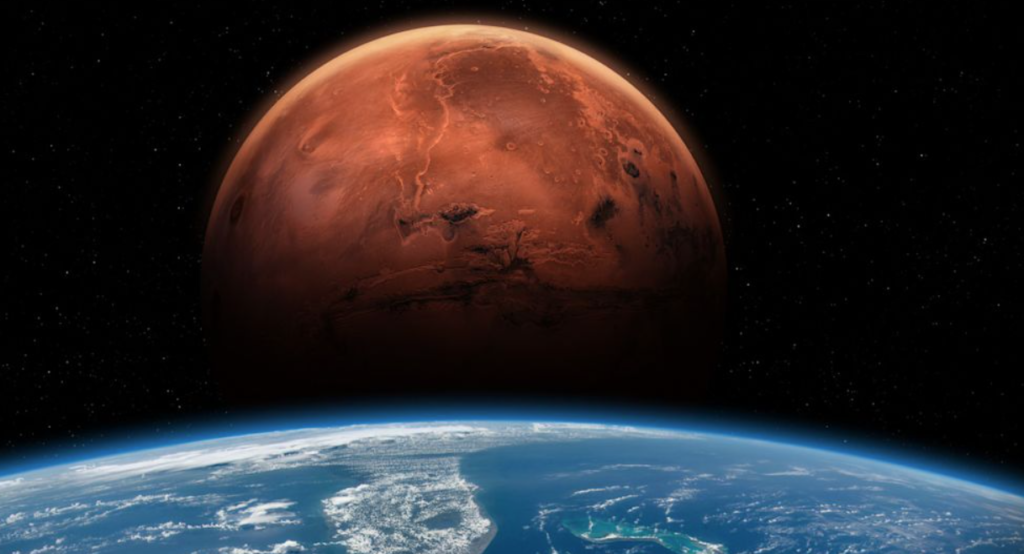
For more than half a century, no spacecraft has ever brought a piece of Mars back to Earth. That could change in 2031 — and increasingly, the mission most likely to get there first isn’t American. China’s Tianwen-3 mission is targeting a launch window in late 2028, with a return to Earth carrying Martian rock and soil by 2031, at a moment when NASA’s own competing effort has stalled under budget pressure and, according to recent reporting, been cancelled outright. Here’s what’s actually happening in the race to bring the first pieces of Mars home.
What Tianwen-3 Actually Is and How It Works
Tianwen-3 is a robotic Mars sample-return mission run by the China National Space Administration, built around a self-contained “grab-and-go” design intended to minimize complexity. The mission consists of five separate spacecraft components: a lander equipped with a drill and a helicopter scout, an ascent vehicle, a service capsule, an orbiter, and an Earth reentry module. Once on the surface, the lander will collect at least 500 grams of Martian material and load it directly into the ascent vehicle, which will launch the sample canister into Mars orbit to dock with the waiting orbiter-returner spacecraft for the trip home.
The Timeline: Why the Launch Window Is Non-Negotiable
Mars launch windows only open roughly every 26 months, driven by the orbital mechanics of Earth and Mars’s relative positions, and Tianwen-3 is targeting the window that runs from December 2028 into January 2029. There’s little room for delay — missing that window would push the entire mission, and its 2031 sample-return target, back by more than two years. The mission will launch on two Long March 5 heavy-lift rockets from the Wenchang Space Launch Site in Hainan, the same rocket family that carried out China’s successful Chang’e-5 and Chang’e-6 lunar sample-return missions, giving CNSA a proven launch vehicle heritage to build on rather than untested hardware.
Why China’s Approach Is Simpler Than NASA’s
Tianwen-3’s design philosophy trades scientific ambition for schedule reliability. Rather than collecting samples from a geologically diverse, scientifically rich location, the mission’s landing site was selected from a review of 86 candidate zones with an emphasis on flat, safe terrain that’s easier to land on. That’s a deliberate contrast with NASA’s approach, where Perseverance has spent more than four years carefully selecting and caching samples from Jezero Crater, a site chosen specifically for its ancient river delta and complex geology that may preserve signs of past microbial life. China’s site will likely be less visually and geologically interesting, but a simpler landing zone meaningfully reduces mission risk on an unforgiving timeline.
What’s Happening to NASA’s Own Mars Sample Return Plan
This is where the race has shifted dramatically in China’s favor. NASA’s Mars Sample Return program, developed jointly with the European Space Agency, was originally approved in 2022 specifically to retrieve the samples Perseverance has already collected and cached on the Martian surface. But the program has faced repeated budget cuts, design overhauls, and schedule slips in the years since, and it was reportedly cancelled in 2026 amid those ongoing funding and design challenges. That leaves NASA without a clear, funded path to retrieve the samples its own rover has already spent years collecting — a strange position for the agency that pioneered Mars exploration to find itself in.
The Scientific Trade-off: Diverse Samples vs a Faster Timeline
Even if China’s samples arrive first, that doesn’t necessarily settle the broader scientific competition. Perseverance’s cached samples come from a site specifically chosen for astrobiological potential, collected through a rigorous, multi-year selection process designed to maximize the odds of finding evidence of past life. Tianwen-3’s samples, drawn from a flatter, less complex landing site chosen primarily for safety, may ultimately prove less scientifically rich even if they reach Earth laboratories years sooner. Being first to return Mars material and being first to make a major scientific discovery from that material aren’t necessarily the same milestone.
China’s Track Record: Why Analysts Take This Seriously
Skepticism about China’s timeline is reasonable given how technically demanding a Mars sample-return mission is, but China’s recent track record gives real weight to the 2031 target. Tianwen-1, China’s first Mars mission, successfully landed the Zhurong rover on Mars’s Utopia Planitia in May 2021, demonstrating the country’s ability to execute a complex interplanetary landing on the first attempt. China has also already successfully returned samples from the Moon twice, through the Chang’e-5 and Chang’e-6 missions, giving its engineers direct, relevant experience with the ascent-and-rendezvous sample-return architecture Tianwen-3 depends on.
International Science Payloads: A Door China Has Opened
Notably, China has reserved payload capacity for international partners on Tianwen-3 — roughly 15 kilograms of mass on the Earth-return spacecraft and another 5 kilograms on the Mars orbiter for outside scientific instruments. Proposals were accepted through mid-2025, with selections finalized later that year and flight hardware due for delivery in 2027. That openness to international collaboration is a notable contrast to the geopolitical framing much of the coverage of this mission has taken, and it suggests China is positioning Tianwen-3 as a scientific opportunity for the broader research community, not purely a national prestige project.
What Experts Say About Who’s Actually Likely to Win
Space policy experts have been increasingly direct about the stakes. One planetary scientist put it bluntly, warning that China may well beat the United States to a Mars grab sample. With NASA’s own sample-return effort reportedly cancelled and no clearly funded replacement plan in place, several experts have argued that returning Mars samples ahead of China should be treated as a genuine national priority rather than a secondary science goal — a notable shift in tone from just a few years ago, when NASA’s mission was still widely assumed to have first-mover advantage by virtue of Perseverance already being on the ground.
Why This Race Matters Beyond Bragging Rights
Being first to physically return Mars material to Earth carries real scientific and symbolic weight. Laboratory analysis of actual Martian samples — as opposed to the handful of Mars meteorites that have reached Earth naturally, which lack the geological context and pristine condition of a targeted, documented sample — could meaningfully advance understanding of the planet’s climate history, geology, and potential for past life. Whoever gets there first will also set the tone for the next phase of Mars exploration, including eventual human missions, at a moment when the balance of capability and ambition in space exploration is shifting in ways that go well beyond who lands on Mars next.